
THANK YOU FOR SUBSCRIBING

Pharma Tech Outlook Weekly Brief
Be first to read the latest tech news, Industry Leader's Insights, and CIO interviews of medium and large enterprises exclusively from Pharma Tech Outlook
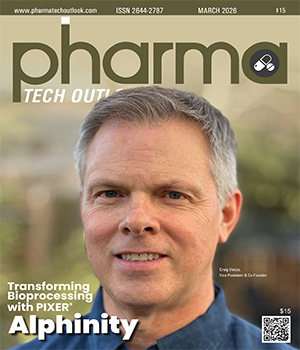
Biomanufacturing demands precision at every turn—whether safeguarding sensitive biologics like monoclonal antibodies and live cells or ensuring accurate flow rates and overall system efficiency. Bioprocessing pumps are at the heart of this operation, entrusted with delivering fluids steadily and consistently. Yet, traditional pumps—hampered by pulsation, shear stress, and inherent inefficiencies—have historically imperiled product integrity and raised operational costs. Alphinity is changing that equation. Evolving from ARTeSYN BioSolutions, a trailblazer in valve technology, Alphinity was founded with a singular mission: to transcend the limitations of conventional peristaltic, diaphragm, and centrifugal pumps. The company’s flagship innovation, PIXER® , is a singleuse component that seamlessly merges pumping and mixing functions while adhering to Pharma 4.0 standards. “Innovation is our heartbeat at Alphinity. With PIXER® , we’re not just refining fluid management—we’re pioneering a new era in bioprocessing where precision, efficiency, and patient well-being converge to deliver transformative, life-saving therapies,” says Craig Vincze, Vice President & Co-Founder.
Steve Madsen, CEO
Serialization in the pharmaceutical industry isn’t just about regulatory compliance—it’s about ensuring patient safety and supply chain integrity. However, achieving compliance can be challenging, as companies often struggle with fragmented systems, data inconsistencies, and the complexity of global regulatory requirements. Many businesses rely on separate serialization solutions that do not integrate with their ERP systems, leading to inefficiencies and gaps in tracking. This is where RxERP changes the game. As the sole provider of a serialized ERP system, RxERP is a trusted partner for pharmaceutical companies seeking an industry-specific, cloud-hosted platform to automate drug serialization and tracking across the supply chain. The platform’s distinctive framework embeds serialization directly into the core ERP system, streamlining compliance, improving visibility, and enabling accurate, real-time data exchange across the supply chain. “Our platform helps ensure adherence to regulations like the Drug Supply Chain Security Act (DSCSA), minimizing risks and maintaining the highest standards for manufacturers, wholesale distributors, and 3PL providers,” says Steve Madsen, CEO of RxERP. This platform additionally features licensure verification, inventory and warehouse management, CRM, and a white-label e-Commerce solution equipped with PCI-compliant checkout capabilities. By consolidating these capabilities into a single system, RxERP eliminates inefficiencies caused by disconnected solutions, allowing pharmaceutical companies to manage end-to-end supply chain operations seamlessly. For pharmaceutical companies, compliance challenges range from product serialization and traceability to maintaining data integrity and regulatory reporting. RxERP addresses these concerns by ensuring that each drug package remains distinctly identifiable throughout its journey, preventing counterfeit products from infiltrating the market. The system safeguards data accuracy regarding product movements, expiration dates, and inventory levels to prevent the distribution of expired medications. It also streamlines regulatory reporting by automatically generating and submitting essential documentation to authorities like the FDA, simplifying an otherwise complex and time consuming process.


Exouza offers OpenPBM.ai, a next-generation pharmacy management administrative platform that empowers employers to better manage rising costs and navigate the complexities of the healthcare ecosystem. By combining intelligent technology, white-glove service and radical flexibility, it drives tangible financial savings, stronger employee engagement and a healthcare experience aligned with current expectations. This forward-thinking solution comes at a critical time. Pharmacy costs are now one of the largest drivers of healthcare spending, and can account for 25 percent of an employer’s total costs. Despite this, traditional pharmacy benefit managers (PBM) continue to rely on outdated, rigid, and opaque models that offer limited transparency, minimal control and little influence on outcomes. Compounding the issue is the high cost of specialty drugs. Although used by only about three percent of the population, the high price of these medications means they account for over half of total drug spending. Much of the complexity and inefficiency surrounding drug pricing is the widely used practice of negotiated rates between PBMs and pharmacies. But this practice does not provide real-time, market-based pricing across a variety of prescription drug suppliers. OpenPBM.ai is the first PBM platform that “shops” for the best price for prescription drugs from multiple sources, not just a contracted rate with a pharmacy, delivering unmatched value to both employers and employees. “Nearly every other industry allows shopping for prices with fully transparency to buyers. Now for the first time, Exouza brings this experience to prescription drug pricing and management. We saw the growing gap and approached it with a blank canvas,” says Susheel Jain, CEO. Rather than adapting outdated systems OpenPBM.ai was built from scratch as a modern, agile, and data-driven PBM platform. Its intuitive app and portal—covering administration, finance, access, clinical management and customer service—are designed with an open architecture to integrate best-in-class capabilities, giving customers the flexibility and customization they need now and in the future. Integration and interoperability with vetted partners and third party systems enables smooth data flow and real-time tracking of member and drug status at every stage. If an issue arises with one partner, OpenPBM.ai immediately identifies the next best route and guides the member to an alternative program or solution, ensuring continuity and support.
Pharma Consulting

James Riddle, MCSE, CIP, CPIA, CRQM, Senior Vice President - Global Review Operations, Advarra
Pharma Manufacturing

Diane Paskiet, Director of Scientific Affairs, West Pharmaceutical Services
Pharma Manufacturing

Armand Matejunas, Sr. Director, Clinical Data Operations, Pacira BioSciences, Inc
Pharma Consulting

Tiffany Anderson, Senior Manager, Global Quality Compliance, Nelson Laboratories, LLC
Pharma Manufacturing

Yan Zhi, Ph.D. Director, Cell & Gene Therapy Product Owner, CSL Behring

eClinical Trial Management
Haichen Yang, MD, MA, MBA, Vice President, Clinical Research, Amicus Therapeutics Inc [NASDAQ: FOLD]

Pharma Consulting
Jennifer Perrin, Director, MMS Holdings Inc
Pharmacy platforms are evolving from mere medication dispensers to integral healthcare components, enhancing clinical decision support, patient engagement, and operational intelligence for improved outcomes.
ESG principles to reduce environmental impact, improve social equity, and enhance governance transparency. This shift drives innovation, builds stakeholder trust, and ensures long-term value for society and business.
Ensuring Defensible Price Transparency for Critical Access Hospitals
The first signal of a credible price transparency solution lies in how it handles data integrity. Many estimators rely on charge master rates or generalized assumptions about payer behavior. That approach may satisfy surface requirements but fails when regulators or payers examine the numbers in detail. A defensible solution ties published rates to actual contract terms and validates them against historical claims and remittance data. For Critical Access Hospitals, which often lack the internal bandwidth to reconcile disparate data sources across chargemasters, pharmacy files, contracts and 835 remittances, the vendor must shoulder that complexity rather than transfer it back to hospital staff.
The patient experience presents a second test of seriousness. CMS requires consumerfriendly estimates for shoppable services, yet hospitals report that multi-step workflows and lengthy questionnaires discourage completion and increase call volume to patient-access teams. An effective platform delivers precision without friction. Real-time estimates that update dynamically as patients adjust variables such as payer, deductible status or copay reduce abandonment and protect staff resources. Accuracy and usability must function together; one without the other undermines both compliance and patient trust.
Leadership accountability now frames the third dimension of evaluation. New CMS requirements effective January 1, 2026 require senior executives to attest to the accuracy of machine-readable files. That shift places personal responsibility on CEOs and Boards. A vendor that merely provides software leaves risk on the hospital’s balance sheet. A partner that stands behind its methodology and compliance process signals a different level of commitment. In an environment where enforcement may expand from verifying file existence to examining internal consistency and data accuracy, traceability becomes central. The ability to follow a published rate back to the contract language, the claim submission and the remittance outcome offers executives the documentation required for confident attestation.
Hospital Pricing Specialists distinguishes itself within this framework through its grounding in real-world reimbursement analysis. Its platform was built by professionals who have worked directly with hospital contracts, claims and payments for decades, translating complex reimbursement logic into patient-friendly estimates while maintaining fidelity to actual payer behavior. By analyzing 837 claims alongside 835 remittance files, it aligns published allowed amounts with what was billed, allowed and ultimately paid, reducing the gap between theoretical pricing and documented payment history.
The company’s hosted file model allows regulatory updates to be implemented centrally, limiting the burden on hospitals with scarce IT resources. Planned audit-trail enhancements are designed to embed traceability directly into future machine-readable files, preparing hospitals for deeper CMS examination. Its written guarantee to assume financial responsibility for CMS price-transparency penalties if a client hospital is found non-compliant further alters the risk profile for leadership teams.
For executives responsible for safeguarding compliance and financial stability, Hospital Pricing Specialists merits consideration as a premier price transparency partner. Its integration of contract terms, claims and remittance validation, combined with executive-level accountability and a compliance guarantee, aligns closely with the governance realities facing Critical Access Hospitals. In a market crowded with surface-level estimators, it presents a disciplined, defensible path forward grounded in documented payment behavior and sustained regulatory vigilance.