
THANK YOU FOR SUBSCRIBING

Pharma Tech Outlook Weekly Brief
Be first to read the latest tech news, Industry Leader's Insights, and CIO interviews of medium and large enterprises exclusively from Pharma Tech Outlook


 Doron Aspitz, CEO
The commercial model that powered the pharmaceutical industry for decades is being rewritten. As medicine becomes more precise and therapies target increasingly narrow patient populations, success is now driven by the ability to systematically ingest, structure, and operationalize fragmented data.
What once relied on broad segmentation and retrospective analysis now demands the continuous integration of complex datasets spanning therapeutic landscapes, patient journeys, and healthcare professionals. When layered with domain-specific business logic and semantic context, this data becomes the foundation for a new kind of commercial intelligence: predictive, dynamic, and deeply embedded in execution. In this environment, success depends not only on identifying opportunities but also on acting on them with speed, clarity, and precision.
How does Verix’s Tovana platform transform fragmented data into actionable commercial intelligence?
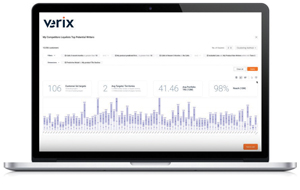
Verix, recognized as the Top AI-Powered Pharma Platform, is built for this new reality. Its patented AI-powered platform, Tovana, is designed not as a conventional analytics solution but as a decision engine for modern pharmaceutical commercialization. Rather than simply adding another analytics layer to existing systems, Verix developed Tovana to help organizations move from fragmented analysis to intelligence-driven execution. The platform continuously analyzes commercial, clinical, and market data to identify emerging growth opportunities and translate them into clear guidance for commercial, brand and field teams.
 “Pharma markets have become far more dynamic and complex,” says Doron Aspitz, CEO. “Commercial teams need clarity on where opportunities exist and how to act on them quickly.”
At the core of Tovana is an infrastructure designed to transform large volumes of data into operational decisions. The platform ingests diverse data sources related to therapeutic landscapes, patient journeys, physician behavior, and market dynamics. This data is organized through a semantic layer and business logic that contextualize the information and make it usable for predictive analysis, all in a single underlying Customer Data Platform (CDP).
Tovana operates a production-grade machine learning environment that runs predictive models across a range of commercial use cases. These models can identify potential patients earlier in their treatment journeys, determine which physicians are most likely to treat them, and predict the likelihood that a healthcare professional will prescribe a particular therapy.
In what way does Tovana deliver insights directly into workflows for commercial teams?
Tovana is designed not just to generate insights but to ensure they reach decision-makers in a usable way. Once opportunities are identified and prioritized, the platform distributes them through the systems that commercial teams already use, including CRM platforms, enterprise workflow tools, and environments such as Microsoft and AWS ecosystems.
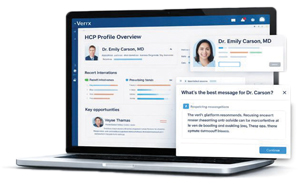 The platform introduces an LLM-powered workflow layer that helps users quickly access interpret recommendations. For example, a field representative might receive a prioritized list of physicians to visit over the coming days. Tovana provides the contextual information behind each recommendation—such as prescribing behavior, patient mix, therapy adoption trends, and churn risk—allowing the representative to understand why a physician was selected and how to approach the engagement.
“Insights are presented in clear business terms so teams can quickly understand where opportunities exist, what is driving them, and how to act,” explains Aspitz.
The impact of this approach is visible in real-world commercial programs. In one rare disease initiative, Verix’s Patient Finder capabilities analyzed longitudinal clinical and treatment patterns to identify patients likely to become eligible for therapy earlier in their treatment journeys. By prioritizing these patients for engagement, the client achieved up to a tenfold increase in patient starts, enabling earlier access to therapy while significantly improving commercial performance.
Beyond rare disease, the platform is delivering measurable gains in oncology as well. By optimizing healthcare professional prioritization, brands have increased new prescriptions by 15 to 25 percent. These gains reflect not only improved targeting but also stronger alignment between strategic planning and field execution.
By transforming raw data into consistent, actionable insights, the platform translates high-level commercial strategy into clear priorities for field teams while providing leadership with visibility into execution. The result is a shared decision framework that aligns brand, analytics, and field teams around the same opportunities.
As artificial intelligence gains momentum in life sciences, Verix is focused on ensuring it delivers meaningful value in everyday commercial decision-making. As the platform has expanded across therapeutic areas, Verix has gained recognition as the Top AI-Powered Pharma Platform, highlighting the growing importance of AI decision engines in modern pharmaceutical commercialization.
By connecting opportunity identification with real-world engagement, Verix is helping commercial teams move beyond fragmented analysis and focus on the opportunities that matter most—while acting on them with greater speed, clarity, and confidence.
What Do AI-Powered Pharma Platforms Do?
AI-Powered Pharma Platforms help pharmaceutical organizations convert fragmented commercial, clinical and market information into timely guidance for planning and execution. Instead of leaving teams to interpret disconnected reports, these systems organize data around patient journeys, physician behavior, therapy adoption and market movement. The goal is to support faster decisions, clearer prioritization and more coordinated action across brand, analytics and field teams. They are increasingly relevant as precision medicine narrows patient populations and makes timely opportunity identification more important.
How Does Verix Apply AI-Driven Intelligence in Pharma Commercialization?
Verix applies AI-Powered Pharma Platforms through Tovana, its patented decision engine for pharmaceutical commercialization. Tovana ingests diverse data sources, structures them through a semantic layer and business logic, and operates on a single underlying Customer Data Platform. It continuously analyzes commercial, clinical and market data to identify growth opportunities and turn them into guidance for commercial, brand and field teams. Verix also uses production-grade machine learning and pharma-trained large language models to make recommendations more relevant to pharmaceutical use cases.
Why Are Predictive Models Important in Modern Pharma Commercial Strategy?
Predictive models help teams recognize signals earlier, especially when patient populations are narrow and market changes develop quickly. AI-Powered Pharma Platforms can evaluate treatment patterns, physician behavior and therapy eligibility to highlight where outreach or planning may have the greatest impact. This allows organizations to move beyond retrospective analysis and focus resources on opportunities that are more likely to matter. Strong predictive analytics also reduces dependence on manual review cycles that can slow launches, territory planning and response to shifting market conditions.
What Capabilities Should Organizations Look for in an AI Pharma Platform?
Organizations should look for data integration, domain-specific modeling, explainable recommendations, workflow delivery and scalable governance. AI-Powered Pharma Platforms are most useful when they combine machine learning with pharmaceutical context rather than functioning as generic reporting tools. The ability to translate complex analysis into plain business guidance is especially important for adoption across commercial leaders, analysts, marketers and field teams. Effective platforms should also make assumptions, signals and next steps understandable enough for cross-functional teams to act with confidence.
How Do These Platforms Support Field and Brand Execution?
AI-Powered Pharma Platforms support execution by turning insight into prioritized actions that can be used inside existing workflows. Recommendations may help field teams understand which physicians to engage, why a priority exists and what market or patient signals support the next step. Workflow delivery through CRM systems, enterprise tools and cloud environments helps commercial intelligence reach users where decisions are already made. This makes strategy more operational, connecting planning with daily decisions in a consistent way.
What Value Can AI-Driven Commercial Intelligence Create for Pharma Teams?
AI-driven commercial intelligence can improve alignment, speed and precision across commercialization programs. AI-Powered Pharma Platforms help teams see emerging patient, physician and market opportunities sooner, then translate those signals into action. In Verix programs, patient-finding models supported earlier therapy identification in rare disease, while physician prioritization work in oncology improved new prescription performance, showing how analytics can influence both access and commercial outcomes.
Company
Verix
Management
Doron Aspitz, CEO
Description
Verix provides AI-driven platforms for optimizing commercial operations in the life sciences and pharmaceutical industries. Its solutions analyze complex data to deliver actionable insights that improve sales, marketing strategies, and decision-making. By integrating advanced analytics and machine learning, it helps organizations enhance performance, identify opportunities, and drive sustainable business growth.