
THANK YOU FOR SUBSCRIBING

Pharma Tech Outlook Weekly Brief
Be first to read the latest tech news, Industry Leader's Insights, and CIO interviews of medium and large enterprises exclusively from Pharma Tech Outlook


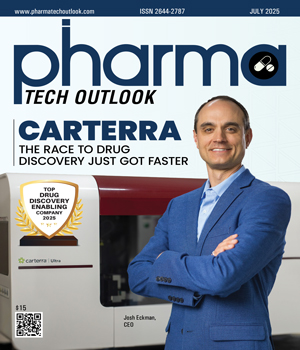
 Josh Eckman, CEO
For decades, drug discovery has relied on screening millions of small molecules and antibody candidates for a breakthrough. To triage potential candidates, researchers rely on low-resolution techniques like fluorescent or radioactive-labeled assays only to get a yes/no answer or a relative binding score. While this process is systematic in nature, promising candidates with weak or fleeting binding often slip through the cracks, lost in the limitations of endpoint assays.
Built on the foundational philosophy of better tools for better science, the biotech instrument company Carterra is changing this status quo. Through its purpose-built products—LSA®, LSAXT, and Ultra—the company is focused on minimizing the risk of false negatives, missed opportunities, and costly failures that derail drug discovery. Designed to deliver high-resolution, speed and throughput, these instruments enable real-time biomolecule binding to analyze interactions between potential drugs and their targets at an unprecedented scale.
“Beyond expediting early-stage pharmaceutical discovery, our technologies remain valuable throughout the entire drug development process,” says Josh Eckman, CEO.
Breaking Barriers to Drug Discovery
Carterra’s large-scale multiplexing and microarray-based technologies offer a superior alternative to the 25-year-old conventional method where just 4 to 8 binding interactions were possible at a time. Researchers can now measure nearly 400 interactions simultaneously—a 50 to 100 times increase in speed, transforming what once took months into just days. They can capture every binding event in real time (just like an EKG readout), detecting even weak or transient interactions. The result is a full binding profile delivering deeper insights into molecular interactions, a significant advantage over simple yes/ no endpoint answers.
Speeding Science, Saving Lives
A prime example is Carterra’s role in the fight against COVID-19. In 2020, Eli Lilly and AbCellera used its instruments to identify and develop an antibody candidate in just 90 days—rapidly advancing to clinical trials when no vaccines were available. By September, Eli Lilly received Emergency Use Authorization to dose high-risk patients. This enabled the company to develop passive immunity in nursing homes and outbreak-prone areas, helping reduce hospitalizations and deaths. The breakthrough, aided by AI and ML tools, was featured in Science, underscoring the power of high-throughput screening.
Another case is when Pfizer first encountered Carterra’s technology in 2014; they recognized it as the missing link in their drug discovery workflow. Pfizer partnered with Carterra to develop the LSA technology, minimizing the risk of overlooking viable drugs, optimizing candidates early to save time and resources, and ultimately enhancing the likelihood of developing life-saving medicines.
The Next Evolution of Carterra’s Technology
Building on this foundation, Ultra represents the next major leap by bringing the same high-resolution, high-throughput SPR capabilities into small molecule discovery for the first time. This breakthrough will enable entirely new applications and scientific advancements that were previously impossible. In early testing with pharmaceutical collaborators, Ultra has already proved its potential.
In one experiment spanning just three to four days, Carterra generated hundreds of thousands of binding interactions—an amount of data that typically takes years to produce using conventional small molecule screening technologies. The scale and speed mark a breakthrough in the field.
With Ultra, researchers can systematically probe compound and fragment libraries against broad panels of drug targets, identifying previously unrecognized binders. The data generated can then be integrated with AI and ML-driven structure-activity relationship (SAR) models, unlocking new approaches to small molecule drug discovery that were not previously possible.
Carterra is currently in the early stages of conducting demos, collaborations, and initial sales for Ultra. While broader adoption is still underway, early clients have offered strong positive feedback on the instrument. As part of its first-wave outreach, the company collaborated with researchers examining kinase interactions with small molecules. With Ultra, researchers screened hundreds of kinases simultaneously on a single chip, replacing the slow, manual process that once limited them to just a few. Researchers then flowed a compound library of 1,000 to 2,000 small molecule fragments across that chip, generating approximately 100,000 data points—a process would have previously taken many months to complete.
“Our technology can be compared to capturing a high-resolution aerial image of an entire forest, letting researchers zoom in on every pocket of vegetation instead of analyzing one tree at a time. With this highly parallel array capability, we revealed how thousands of compounds interacted across the full kinome within a single automated experiment,” says Eckman.
This level of rich data will fuel discoveries for years and with AI and machine learning, that potential only grows. Researchers can now explore compound specificity and off-target effects much earlier in the drug discovery, closing the door to scientific “tunnel visions” and late-stage failures.
The Future of Drug Discovery
Carterra has witnessed strong early success in targeted protein degraders (TPDs), an area that has received significant investment in pharma, particularly with Proteolysis-Targeting Chimeras (PROTACs). This is a complex and geometrically scaling field where different warheads, linkers, and binders create an exponentially growing number of combinations that need to be tested. Traditional methods struggle to handle this complexity, but Ultra’s multiplexed array-based technology enables rapid, large-scale screening, allowing researchers to quickly identify the most promising candidates.
Similarly, in the field of molecular glues, Ultra has empowered customers to conduct large-scale multiplexed screens, accelerating the pace of discovery. These innovations mark a fundamental shift in how small molecule drug discovery is conducted, making previously impractical research questions feasible and unlocking new scientific frontiers.
“Our product trio and Carterra as a whole are transforming the pace of scientific discovery. This acceleration opens the door to asking bigger, bolder questions and exploring new frontiers in science, leading to breakthroughs and groundbreaking discoveries,” says Eckman.

Company
Carterra
Management
Josh Eckman, CEO
Description
Carterra is a pioneering biotech tools company revolutionizing drug discovery with its high-throughput Surface Plasmon Resonance technology. By combining patented microfluidics, real-time analysis, and advanced visualization software, it accelerates large and small molecule screening—empowering pharmaceutical companies, biotech firms, and researchers to develop life-saving therapies faster, more efficiently, and with unparalleled precision.