
THANK YOU FOR SUBSCRIBING

Pharma Tech Outlook Weekly Brief
Be first to read the latest tech news, Industry Leader's Insights, and CIO interviews of medium and large enterprises exclusively from Pharma Tech Outlook


 Larry E. Elvebak, President
This workflow, while established, creates significant friction. Data must be pulled from Watson in formats that require manual adjustment. Templates are often scattered across network folders, slowing access. Copy-paste transfers introduce the risk of error, forcing quality control reviewers to check line by line. As a result, reports that should move quickly can stretch into months.
LabIntegrity was created to close these gaps. The company brings decades of experience in laboratory informatics and developed StudyDoc, a system that connects directly to the Watson Oracle database, structures the data, and delivers ready-to-use drafts. What once stalled in manual transfers now flows faster and more accurately, giving labs a path to quicker, regulator-ready reporting while easing the quality control burden that previously weighed teams down.
“StudyDoc is true off-the-shelf software, unlike rigid tools. It adapts to any workflow and can generate full or partial reports, giving labs flexibility competitors cannot match,” says Larry E. Elvebak, president.
StudyDoc: Practical Automation for Bioanalysis Reports
StudyDoc works directly with Thermo Scientific Watson LIMS, the industry standard for bioanalysis study design and compliant data storage. The software retrieves raw study data from the Watson Oracle database, generates properly formatted tables, enters in the report body table-specific statistical variables (such as minimums and maximums of accuracies and precision) and reports stability conditions, automatically hyperlinks tables to appropriate references in the report, and builds a draft report at the push of a button. A writer can receive a report that is already 80 percent complete. Competitors often require rigid workflows where every study looks the same. StudyDoc, however, accepts the reality of CROs and labs that handle multiple study designs. Configuration settings adapt to each client’s approach, making the tool practical rather than prescriptive.
Future Ready through Innovation
Regulations are evolving. ICH M10 guidelines now require detailed descriptions of methods, procedures, and instrument settings in bioanalysis reports, rather than just in lab notebooks. This adds manual work for teams copying information from ELNs, often in poor formats. LabIntegrity plans to integrate StudyDoc with ELN vendors to automate this transfer, leveraging API connections and database access despite ELN standardization challenges.
Data integrity remains central. Since 2013, the FDA has warned about cut-and-paste errors. Many labs still rely on manual systems, leaving room for mistakes or fraud. StudyDoc mitigates this risk by creating reports in a secure environment where every action is tracked. Clients can review hashed documents with unalterable tracked changes, providing reassurance and compliance.
In the coming months, LabIntegrity anticipates more demand for automation that balances flexibility with compliance. The StudyDoc platform is positioned to meet that demand. Labs want reports that are faster, more accurate, and regulator-ready. They also want the freedom to design studies in their own way. LabIntegrity delivers on both counts, which explains why its solution has become a trusted tool for CROs, labs, and pharma companies alike.
Company
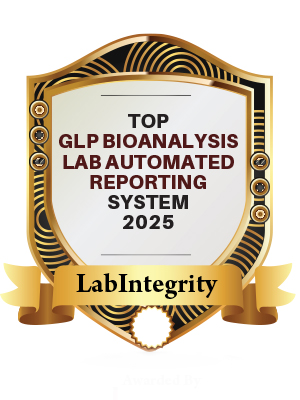
LabIntegrity
Management
Larry E. Elvebak, President
Description
LabIntegrity delivers automation and data integrity solutions for GLP bioanalysis labs. Its flagship product, StudyDoc, integrates with Watson LIMS to generate accurate, regulator-ready reports faster. By reducing manual effort, eliminating errors, and strengthening compliance, the company helps CROs and pharma organizations streamline reporting workflows while meeting evolving regulatory demands.