

THANK YOU FOR SUBSCRIBING

Pharma Tech Outlook Weekly Brief
Be first to read the latest tech news, Industry Leader's Insights, and CIO interviews of medium and large enterprises exclusively from Pharma Tech Outlook
A featured contribution from Leadership Perspectives: a curated forum reserved for leaders nominated by our subscribers and vetted by our Pharma Tech Outlook Advisory Board.


Success in today’s complex world of biological drugs demands a well thought out drug development workflow. Strategies to mitigate risks and reduce development costs are in the focus. One major tool used for risk mitigation is the performance of advanced analytics, using state-of-the-art analytical technologies and methodologies, very early in the biologics drug development process. Analytical biologics characterization has become an essential basis for a successful biological drug development.
Regulatory considerations
As per ICH Guideline Q6B, the goal of a biological product characterization is the generation of in-depth knowledge of the product’s physicochemical and immunochemical properties, biological activity, molecule variants (purity, impurities), contaminants as well as protein quantity. The data generated is used for establishment of specifications, identification of critical product quality attributes, to facilitate process design optimizations, and to ensure that the product attains critical safety, purity, and potency. The performance of physicochemical characterization analytics is usually emphasized in pre-clinical and clinical phase I development stage, e.g. to establish a reference standard batch which needs an initial characterization. Analytical characterization also supports later stages of the drug development when comparability assessments are performed to ensure product quality e.g. when process changes are introduced. At late-stage submission, the drug product should have been analytically compared with an appropriate reference standard.
Complexity of biological drug products
There are many factors relevant for elaborating complexity of biologics products and the impact of these factors on product quality. Some key attributes that make large molecule drugs complex are related to the biological manufacturing process. The bulk products manufactured consist of multiple variants with a natural product heterogeneity which is introduced by the cellular expression system. At the early stages of drug development many quality attributes of the drugs are yet unknown and need to be built up based on analytical data. A comprehensive analytical characterization of the molecule is at this stage achieved by applying multiple orthogonal and complementary analytical methodologies and technologies. The combination of all individual results derived of these assays represents the comprehensive characterization result.
Comprehensive early phase physicochemical biologics characterization strategy
Comprehensive characterization strategies typically focus on assessing four main areas:
Due to the natural product variability of biologics drugs produced in a cellular expression system, alterations and heterogeneities in the product can result in decreased product efficacy, reduced stability, or increased immunogenicity.
"One major tool used for risk mitigation is the performance of advanced analytics, using state-of-the-art analytical technologies and methodologies, very early in the biologics drug development process"
For example, highly successful biologics product classes like Immunoglobulin G based monoclonal antibodies (mAB) consist of N-glycosylation sites in the crystallizable (FC)-region. The host cell lines, applied fermentation conditions and the growth cell media used for biologic product manufacturing can influence the extent and nature of the glycosylation variants distribution. Thus the overall heterogeneity of the product is influenced by the heterogeneity of the N-glycosylation variants. Depending on the content and N-glycan variants present, a possible implication can be potential immunogenicity effects or altered pharmacokinetic and pharmacodynamic properties.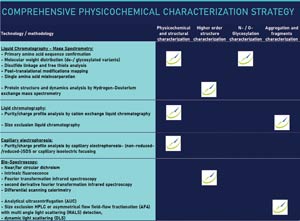
The confirmation of the primary protein structure of mABs, specifically the correct amino acid sequence in the complimentary determining regions (CDR) involved in target antigen binding is key to ensure correct effector function of the drug. Misincorporation of single amino acids or post-translational modifications within the CDRs can affect target antigen binding. Structural changes may also lead to altered higher order structure of the protein, which may result in decreased stability and/or decrease or loss of efficacy of the molecule. The structural integrity of the biologic should be closely monitored at early drug development stage to identify potential critical quality attributes.
Concluding
Comprehensive analytical characterization of biological products at early development stage enables the establishment of risk mitigation strategies. Data generated with state-of-the-art technologies/analytical methodologies support key milestones in early development like clone selections, development of optimized manufacturing and/or downstream process as well as characterization of engineering batches, toxicology batches, bulk drug substance batches and reference standards. Characterization analytics further support comparability/similarity studies, for example to assess changing processes or change of manufacturing sites as well as batch-to-batch comparability, stability studies or biosimilar/originator comparability.
Biography
Rafael Sande holds a Master of Science degree in Life Sciences. He has more than a decade hands on industry experience in the field of analytical characterization testing of new biologics and cell and gene therapy products drug developments with core competence in Mass spectrometry-based characterization analytics. Since beginning of 2022 he is in his current role as Head Operations Characterization at Solvias AG, an analytically focused contract research organization, where he leads a >50 FTE department responsible for providing full analytical characterization expert solutions for the Life Sciences industry including Bio- Mass Spectrometry, Bio-Spectroscopy, Amino Acid analysis, Molecular Biology and Chromatography services.
