
THANK YOU FOR SUBSCRIBING

Pharma Tech Outlook Weekly Brief
Be first to read the latest tech news, Industry Leader's Insights, and CIO interviews of medium and large enterprises exclusively from Pharma Tech Outlook


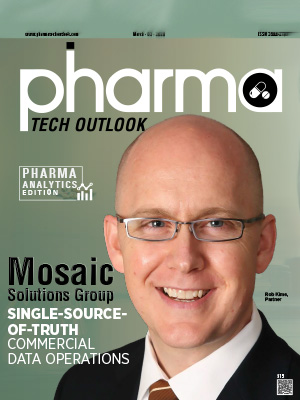
 Rob Kime, Partner
The complexity of pharma data is coupled with an infrastructure problem—most commercial teams lack the ability to consolidate their data assets in a single data management environment. Fragmented data creates inefficiencies and frustration as operational teams spend time integrating data required to meet operational and analytical needs. Analysts commonly admit they spend most of their time cleaning and organizing data, leaving little time for developing useful insights or deliverables.
A growing number of companies offer solutions to meet this need, including Atlanta-based Mosaic Solutions Group. We spoke briefly with Rob Kime, a founding partner at Mosaic. According to Kime, Mosaic offers some unique advantages. Mosaic does not build a data warehouse for its clients since development projects generally focus on a current, static set of data assets. “That’s not efficient or realistic,” says Kime. “Inevitably, the requirements change, often before a project comes to completion, and the model has to be refactored, which is expensive and time-consuming.” Rather than building a data warehouse from the ground up, Mosaic leverages a proven, flexible model capable of assimilating each client’s commercial data assets into a client-specific, cloud-based, data warehouse. The model is designed to house all of a client’s commercial data and feed all downstream data consumers; a single-source-of-truth or SSoT. Mosaic advocates this single point of application for all business rules and logic as a way to eliminate operational inefficiencies and discrepancies in business intelligence.

Mosaic provides automated, cloud-based, single-source-of-truth commercial data operations and customized business intelligence using their highly scalable, modular infrastructure to meet clients’ constant need for change

For most members of the commercial team, data operations are unseen and unknown. Generally, the manifestation of effective data operations is business intelligence deliverables. “Every client is different” says Kime. “Some want to use an application like Tableau to generate reporting and dashboards. We build and maintain the data marts they need to support that activity inside their warehouse. Most of our clients want customized reporting deliverables, whether PDF or Excel, that get generated in our business intelligence platform and pushed automatically to different user groups. We have a strong development team that translates a customer’s vision into production deliverables.” Mosaic also provides a suite of applications to support data access and analytics across a range of skill sets common to commercial teams in pharma. “We have clients who want to write SQL code, and they have direct access to their warehouse. More often, we see clients taking advantage of a drag-and-drop interface we created to let an average commercial user generate very complex queries and extracts in just a few minutes,” adds Kime.
“Certainly, technology and method are important. We think we offer some unique advantages,” says Kime. The Mosaic team takes an obvious pride in their unique background and entrepreneurial history. “There’s no question clients benefit from our many years of experience in client-side operational roles and even field sales. We have built our company on that first-hand understanding of our client’s challenges. Combining that perspective with our nationally recognized technical team creates a definitive advantage for our clients,” he concludes.

Company
Mosaic Solutions Group
Management
Rob Kime, Partner
Description
Mosaic Solutions Group provides a one-of-a-kind commercial data warehouse for pharmaceutical and biotech companies. This cloud-based single-tenant multi-server data management environment is a single source of truth where every commercial data asset can be integrated. Although Mosaic does not build its own data warehouse, it provides a model for the same, which can react to scale and flexibility, allowing the pharmaceutical companies an easy integration of new data assets and hassle-free application of new business rules. Mosaic gives clients a way to assimilate and integrate all their syndicated or non-retail data feeds and any other commercial data asset that the sales and marketing team is going to use