Carterra launches the world’s first 48-channel SPR platform eclipsing current 8-channel platforms on the market
For more than two decades, drug discovery scientists have pushed surface plasmon resonance (SPR) technology to reveal kinetic truths that no other analytical method could deliver. Yet despite SPR’s central role in fragment-based discovery, small-molecule analysis, and antibody discovery, its throughput has remained a persistent bottleneck. Today’s AI-driven discovery pipelines rely on volumes of accurate, real-time interaction data to make confident predictions about binding, selectivity, and developability. While the biological questions have evolved, the technology enabling them has not—until now.
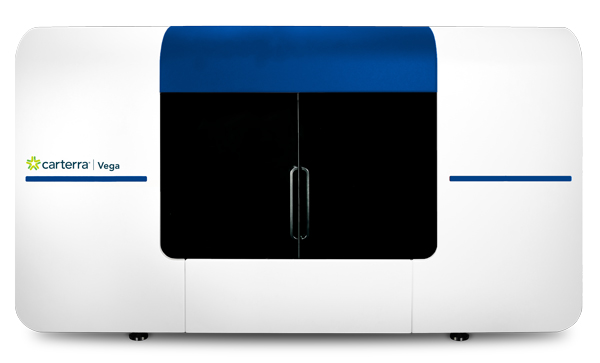
In February 2026, Carterra launched Vega, a next-generation SPR platform engineered as a step-change in the scale and speed of early discovery. This new platform lifts longstanding throughput constraints by introducing 48 parallel channels in a single SPR instrument and, when paired with its optional robotic handler, enables screening of more than 20,000 compounds in a single 24-hour period. This automated platform expands not only the scale of experiments but also the versatility of assays one can run, allowing a variety of workflows and assay orientations to run seamlessly in unattended campaigns.
The true significance of Vega extends beyond the number of channels. It lies in how this level of capability compresses early R&D timelines, ensures that researchers have the data to make better decisions on drug candidates earlier in the process, and helps bring new therapies to patients faster.
 The Need for More Throughput
Until now, scientists working with SPR have had to strike a compromise between experimental depth and experimental scale. Traditional eight-channel systems could answer detailed kinetic questions, but only at a pace that forced teams to limit library sizes and prioritize narrow sets of targets. Vega eliminates that trade-off entirely. By collecting data at this higher scale, researchers can rapidly evaluate vast libraries of fragments and small molecules in ways that were previously impractical or impossible. Just as critically, Vega expands Carterra’s signature one-on-many array architecture to include many-on-few assay designs, the traditional small molecule screening paradigm.
These deeper datasets provided by Vega create opportunities to identify rare chemotypes, uncover weak or transient interactions that would otherwise be missed, and reveal off-target profiles that inform safety and lead optimization much earlier in the process.
A Platform Built for the Era of AI-Driven Discovery
Vega arrives at the precise moment drug discovery is shifting toward AI-driven workflows. The need for high-quality data to feed these models is unfolding amid tightening R&D budgets and growing pressure on teams to work faster, consume less sample, and generate more broadly applicable insights.
Vega directly addresses this challenge by producing high-fidelity binding data at a scale previously unattainable in SPR. Its ability to detect interactions for analytes as small as 100 Da and at temperatures down to 10°C allows researchers to capture subtle molecular events, including weak fragment interactions that often reveal entirely new binding pockets. These nuanced datasets flow seamlessly into computational platforms, strengthening the predictive power of AI and closing the loop between in silico design and empirical validation.